SAT 101 Chapter 3 - Rules
Just Another Game with Rules
The Most Important Concept
The SAT is nothing but a game bound by certain rules, and we can exploit them.
Figure 1.3
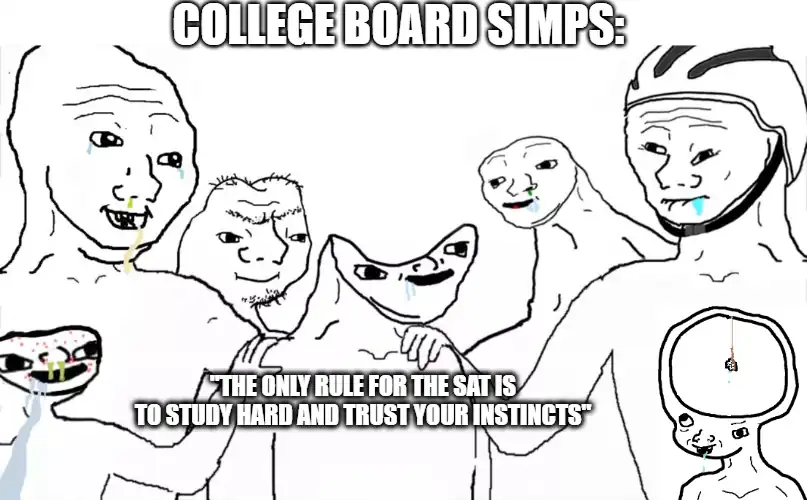
Listen close, fellas, 'cause this might just be the most important chapter.
Because the SAT has to be taken by millions of people all over the world, it has certain limitations that we can use to our advantage. Unlike most multiple choice tests you’ve taken, there can be no room for argument or uncertainty for a test of such scale. There is no arguing with your teacher that you should get credit for a certain answer choice – if it’s wrong, it’s wrong.
This need to be 100% logical and correct leaves a lot of room for us to find tricks and exploits in the test design.
There’s probably been many times where you thought your answer on the SAT was more correct than the actual answer. And you’re not necessarily wrong. That’s just not how the SAT sees it. Them dang boomers ain't used to freedom of thought.
In case you didn't hear me the first time
THE SAT IS NOTHING BUT A GAME BOUND BY CERTAIN RULES, AND WE CAN EXPLOIT THEM.
The Rules of the Game
Rule 1: There is only 1 good answer per question
Notice how I didn't say there is only 1 "technically correct" answer, or 1 "best" answer, or anything along those lines. No, what I said was that there is only one good answer. Only one of the answers is going to be a decent answer.
If you think two answers are pretty good, shut up and think again.
If that seems wrong to you, you're right! It's fuckin' stupid. But we still have to think like this and follow this rule, because that's just how the SAT is designed.
Most of our life, we are taught to question things and argue for best answers. Teachers often say to choose the best answer on their test because they know multiple answers can be good, but only one is better than the rest. Like I said, throw all that crap out the window.
It's not natural, but if you hammer this into your brain and think like this during the text, it will help you so much.
SAT RULE #1
THERE IS ONLY ONE GOOD ANSWER. ONLY ONE DECENT ANSWER. ONLY ONE SINGLE FUCKING ANSWER THAT IS EVEN REMOTELY ACCEPTABLE.
Rule 2: Three answers are completely WRONG
It might sound like I'm just repeating myself, but these are actually two distinct concepts, even if they are closely related. Seriously, I cannot stress how important this stuff is.
Too often, we get stuck in the mindset of finding the best answer. We assume multiple answers can be pretty good and we try to choose the one that's the "most good." If you do this, you will not do well on the SAT. Simple as that.
Like I mentioned before, a standardized test like the SAT needs to be as argument-proof and watertight as possible, because so many millions of people take it. That means they can't have a question with two good answers - they would get too much shit for it and we would fuckin' cancel their asses. Luckily, this actually makes things easier for us.
Any time you are between two questions, remember that one of them is TOTALLY WRONG for a SPECIFIC REASON. Cross that one out, and you have your answer.
Train yourself to look for what is wrong rather than what is right, and it becomes so much easier to narrow down answers. When you view multiple answers as potentially good, you start looking for reasons to like answers. You might as well look for reasons to drop out of school at that point. That kind of thinking makes bad answers sound better, and good answers sound similar to bad answers.
SAT RULE #2
EVERY WRONG ANSWER HAS A SPECIFIC REASON IT IS COMPLETELY AND UNARGUABLY WRONG. FIND THAT THING, AND YOU BEAT THE DAMN GAME!
Rule 3: Every single word matters
The SAT is full of answers deliberately designed to trick you. They know how you think and they exploit it - I just picture these crusty old boomers giggling to themselves, overcome with titillation as they find new ways to give you test anxiety. Well, screw 'em. I've figured out their traps so you don't have to.
There are a bunch of trap types specific to each section, so you'll have to go to Math, Writing, or Reading for more specific tips, but here are the basics.
Every single word matters, no matter how small or insignificant it may seem. The SAT writers know that you might glance over a word here or there, and they're ready to fuck you up for it. So make sure you read every single word in the question and answers. Especially look out for words that change the meaning of a phrase in very slight ways like "almost," "always," "sometimes," or anything like that.
The difference between words like "sometimes" and "rarely" might not matter much in real life, but it is the difference between a right and wrong answer on the SAT.
SAT RULE #3
EVERY SINGLE DAMN WORD MATTERS. READ AND NOTICE EVERY WORD OR I WILL HUNT YOU DOWN
Rule 4: Every question is worth the same amount
Another basic rule of the SAT is that all questions are worth the same, whether they are easy or hard. This means that we should never prioritize harder questions over easy ones.
The first thing you do while studying should be to minimize errors on easy questions. If you are making careless mistakes, it doesn’t matter whether you know the higher level math content or not - you're losing points on the easiest, most basic questions.
If you miss 5 easy questions because you tried to do them too quickly, you will get a lower score than the person who did those 5 easy questions slowly and then guessed on the harder ones. That person probably got 1 or 2 of those guesses right, and beat you because they also got all those easy ones right.
The same goes for reading questions and passages. If a passage is extremely hard and you are running out of time, it's okay to just leave it and get the next one done. You have to know when to cut your losses.
SAT RULE #4
EVERY QUESTION IS WORTH THE SAME DAMN AMOUNT. MAKE SURE YOU GET THE EASY QUESTIONS RIGHT BEFORE EVEN THINKING ABOUT HARDER ONES.
Rule 5: There are no hard questions
"b-b-bu-but but senpai! You just said to do easy questions before hard ones!! You lied!!! REEEEEEEEEEEEEEEEEEEEE!!!!"
Bear with me here. Obviously, some questions are more difficult than others. But the thing is, the sat is designed so that all questions can be answered quickly and efficiently, so long as you notice certain details and shortcuts. All the SAT does is ask about basic concepts in roundabout and confusing ways.
So while questions can definitely be "hard," these questions are really just easy questions hiding under a steaming pile of bullshit and big words. This applies to all three sections.
On the reading section, you might feel like you need to make some complicated literary inference about the meaning or message of a passage. Hell naw. The answer is directly written in the text somewhere, you just have to find it.
On the writing section, a question might involve a sentence that looks so complex you can't even begin to understand it. But I promise you the sentence is just filled with garbage like commas and unnecessary descriptions. Strip away the bullshit, and it's a simple question about a simple sentence.
On the math section especially, I find this rule to be essential. If you ever feel like a math problem just involves math totally beyond your level, or concepts you've never even began to understand, remind yourself that it is always a relatively basic concept underneath. The SAT will just take that simple concept and throw crap like fractions, exponents, and complicated word problems around it.
SAT RULE #5
THERE ARE NO HARD QUESTIONS. ONLY EASY QUESTIONS IN DISGUISE.