SAT 101 Chapter 6 - Effective Studying
Now that we've gone over most of the overall basics for the SAT, it's time to talk about the next important part - how to actually study.
You can't study for the SAT like you would a more traditional test because it doesn't test traditional concepts. Most of us are used to studying for tests by reviewing relevant concepts and memorizing information that we think is going to be on the test. The thing is, the SAT does not test your knowledge of information. It tests your sense of logic, and your ability to understand the test at an atomic level. That's what all those rules I taught you were about.
Figure 1.6
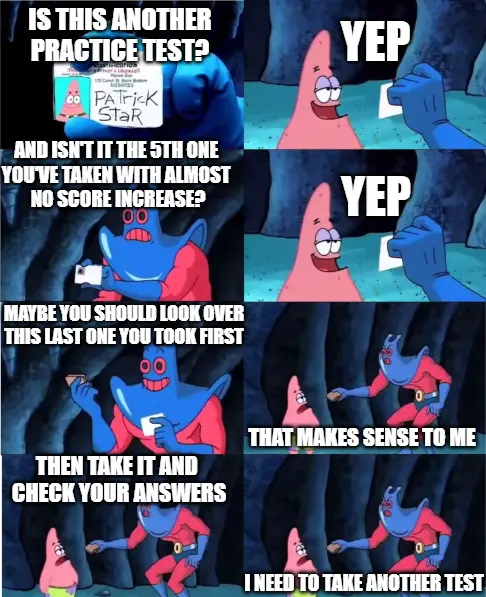
Don't just take practice tests
A lot of people self-study like they have no life, binging practice test after practice test, and barely improve their score. That's because they are fundamentally misunderstanding how to get better at the SAT. Every SAT will have very different questions, and just taking a bunch of practice tests expecting them to help you on future SATs is idiotic.
Instead, after scoring your practice test you need to examine each question carefully and figure out exactly how the SAT is designed. The SAT might not repeat exact questions, but it definitely repeats patterns. Really focus on your thought process throughout each question, and pinpoint the exact point in that thought process where you went wrong. Find the rule you broke or the mistake you made. Eventually, you will start seeing patterns in the questions and stop making those errors.
Don't just mark the right answer and think "oh okay, I'll get it next time" or "I don't really understand this answer, but maybe it's just extra hard."
This is especially important on the reading section
It's relatively straightforward to see the grammar mistake you made or the math error you committed. What's much more difficult is analyzing why you got a particular reading question wrong when you absolutely swear that yours makes sense. But it's extremely important for you to get on the same page as the SAT's answers. If you don't, you will 100% make the same mistake again.
The right way to take practice tests
Take your time
When you first start practicing, I'd recommend not worrying too much about time. It's good to keep track of it, but let yourself take as much time as you need to answer every question. This is crucial in order for you to start understanding the patterns behind each question. Once you get a better understanding, then you can start focusing on speeding up. Trying to go fast when you don't know jack shit to begin with makes no sense, and you should be ashamed if you do that.
Mark down any hard or confusing questions
Additionally, you want to mark hard questions even when you get them right. A lot of times people will take really long on one question, or even guess, but they didn't mark it down in any way. So when it comes time to check their answers, they just see that they got it right and move on, forgetting that it could have been pure luck. You need to go back and analyze those questions to see if there were shortcuts you missed or better methods you overlooked.
Ask yourself why you chose the wrong answer
When you get a question wrong, don't just focus on understanding the right answer. It's equally important, sometimes even more important, to understand why you picked the wrong answer. What was it about the question that tricked you? Did you miss a certain word, or what?
You also want to ask yourself "How could I change the wording of this answer to make it a correct answer?" This is a brilliant way to practice because it forces you to think about the design of the test, and what constitutes a correct answer. Much of the time, wrong answers are only slightly wrong, and if you can pinpoint those reasons, you will stop falling for those traps.
Consider what you've learned from each test
It's not enough to just determine why the answer to a particular question is right. You need to consider the logic and patterns that led to that answer being right, otherwise it won't really help you on future tests. Always ask yourself "How might this question help me understand future questions?" Maybe you'll notice that a particular type of math problem often has a similar type of shortcut, or that even reading questions about the author's personality always have textual evidence.
Where to begin
I think it's time. You're finally ready to graduate. You've taken SAT 101, you've learned the basics, and it's time to take a practice test. So go forth, my spawn, and take that test. You can find links and more on the next page.